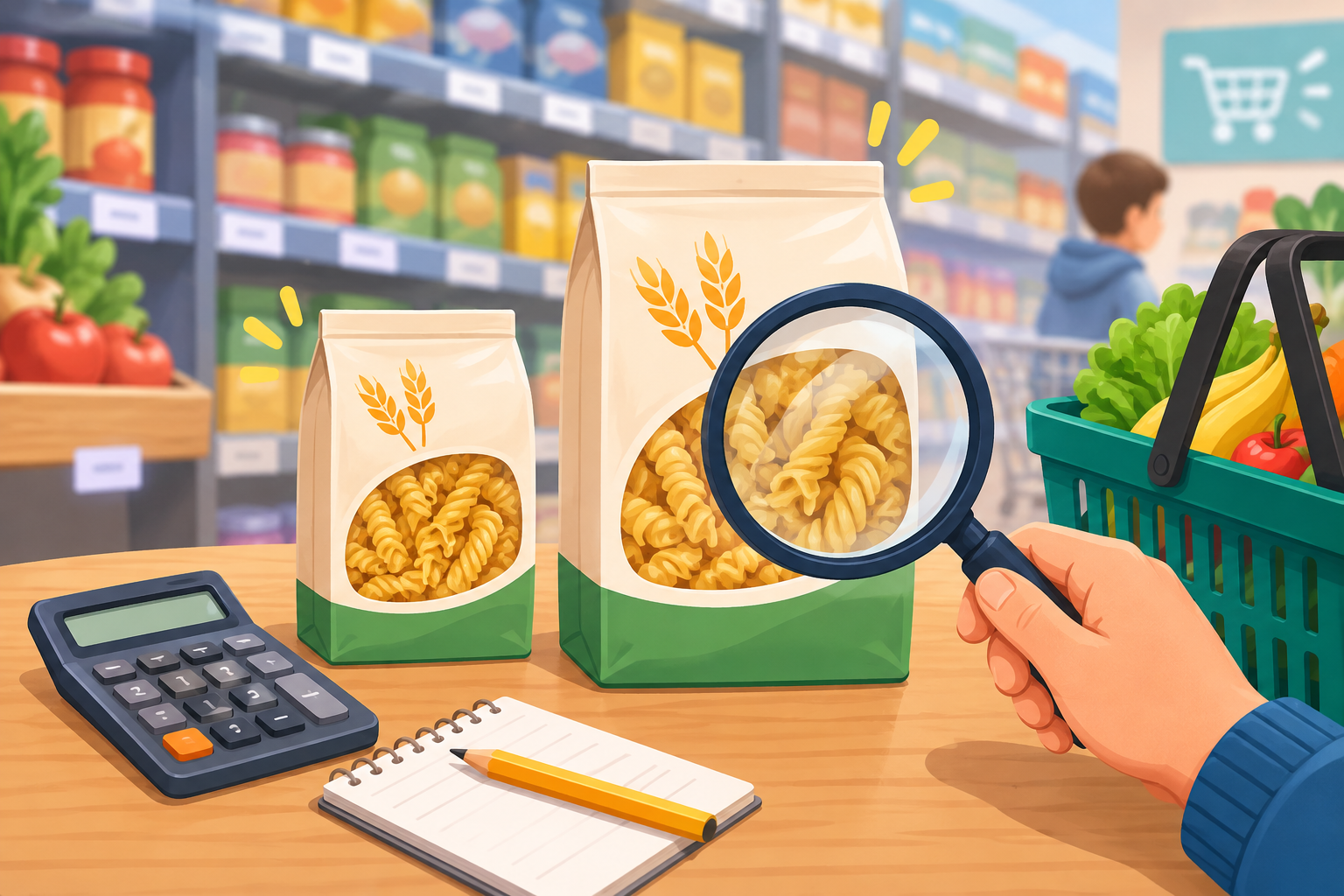
A large packet can look like better value because it contains more. A bright sale label can make one option feel like the obvious choice. The Unit-Price Hunt is a short activity that slows the decision down: compare the cost per same amount, then ask whether you will use what you buy.
New Zealand’s Consumer Protection guidance explains that unit prices let shoppers compare the same type of item across different sizes and packaging. Many covered grocery products must show a standard unit price, but the rules do not cover every product or every retailer. When a label is missing, you can still practise the calculation with sample cards.
Set up the hunt
Choose two or three similar products, such as rice, cereal or milk. Use a supermarket shelf, a printed flyer, or made-up price cards at home or in class. Do not photograph or record another shopper’s payment details. Give everyone a simple worksheet with four columns: item, total price, amount, and price per standard unit.
Compare the same measure
For a practice example, imagine a 500-gram bag costs $4.50. It costs 90 cents per 100 grams because five 100-gram portions fit in the bag and $4.50 divided by five is $0.90. Now imagine a 750-gram bag costs $6.00. Its unit price is 80 cents per 100 grams. The larger bag is cheaper per 100 grams in this invented example, but it still costs more at the checkout.
Ask learners to check that both products use the same unit before comparing. Per 100 grams cannot be compared directly with per kilogram until the amounts are converted to a common measure. For liquids, the label may use litres or 100 millilitres.
Add the real-life question
Unit price is one clue, not the whole decision. Does the household need that much? Is there room to store it? Could some spoil or go unused? Is one option a different product or quality? Can the shopper afford the larger total today? A lower unit price does not make an unnecessary purchase worthwhile.
Finish with a one-minute debrief
Have each person share one surprise, one calculation they checked, and one reason they might choose the option with the higher unit price. A smaller pack can be a sensible choice when it matches the amount needed, fits the available cash, or avoids waste. The goal is not to crown a perfect shopper; it is to practise reading the information before deciding.
Consumer Protection’s unit-pricing guide has examples of comparing package sizes and notes that not every product is covered. Keep the activity fictional if learners should not share family shopping details.
FAQs
What is a unit price?
It is the cost expressed for a standard amount, such as a kilogram, litre or 100 grams, so similar items can be compared.
Is the bigger package always better value?
No. Compare the unit price, total checkout cost, amount needed and whether the product can be used before it is wasted.
Can I compare different units directly?
Convert them to the same measure first. For example, change kilograms to grams or litres to millilitres before comparing.
Do all supermarket items have to show a unit price?
No. New Zealand’s unit-pricing rules cover many grocery products and eligible retailers, but there are exceptions.
Can we do the activity without visiting a shop?
Yes. Use sample cards, a flyer or made-up prices so everyone can practise without sharing personal purchases.
What is the lesson if the cheapest unit price is not chosen?
The decision can still be thoughtful if the shopper considered total cost, amount needed, storage and likely waste.
Leave a Reply